Bubble dynamics and tomography of bubbling beds
Why it matters
Bubbles do the work in many reactors. In bubble columns and fluidized beds, how bubbles rise, deform, interact and break up sets mixing, interphase mass and heat transfer, and so reactor performance. Design and scale-up therefore depend on understanding bubble behaviour from a single bubble up to a whole bed.
The problem
- A bubble’s shape, path and wake change with its size and the liquid’s properties, and the wake controls how bubbles interact.
- Narrow columns are convenient for visualisation, but the walls change the flow, and it is not obvious by how much.
- Inside an opaque fluidized bed bubbles cannot be seen, and tomographic images have to be turned into bubble size, velocity and frequency by a processing step that is easy to get wrong.
What we do
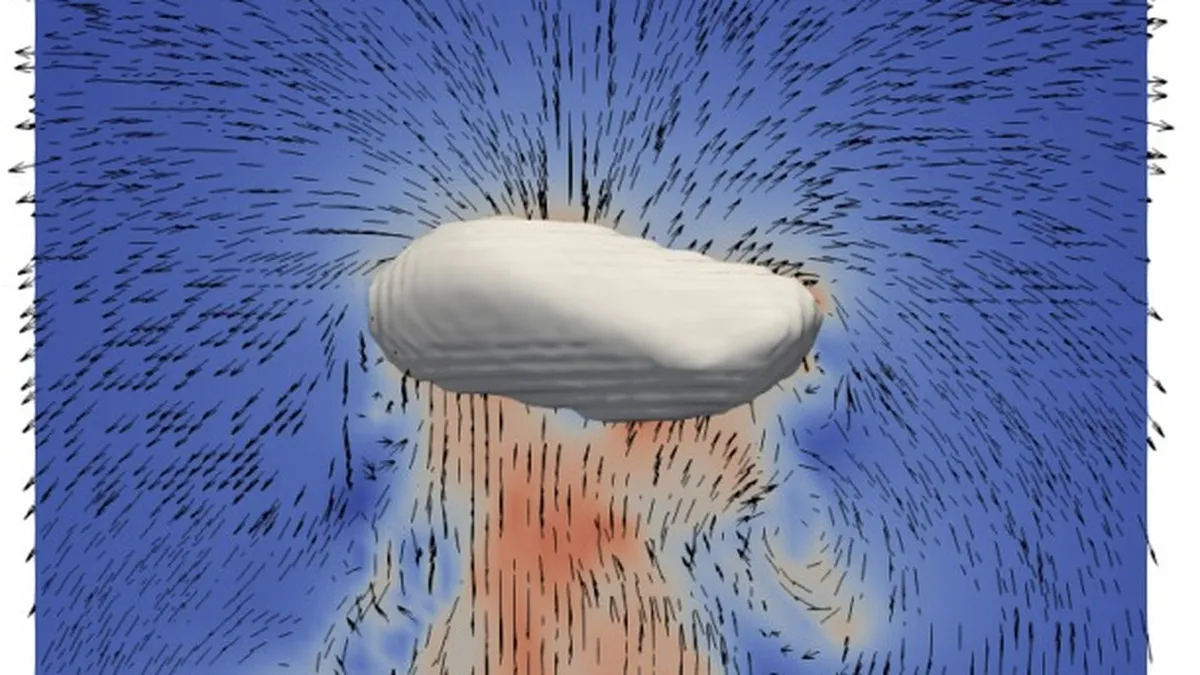
- Single bubbles. Three-dimensional volume-of-fluid simulations of bubbles in viscous liquids and in water, covering shape, wake structure, drag, and the production and dissipation of turbulent kinetic energy around the bubble.
- Interacting bubbles. Pairs of bubbles rising in line, and the conditions under which the trailing bubble collides and coalesces or is deflected.
- Confined bubbles. Bubbles rising between parallel plates (pseudo-2D columns), and how gap size and inertia change the wake and the bubble path.
- Bubble columns and beds. Pressure-fluctuation analysis of bubble column dynamics, and ECVT measurements of bubbles in a laboratory bubbling fluidized bed.
Approach
The simulation work resolves the bubble surface and the flow around it, and results are compared with published experimental observations. For the fluidized bed, ECVT gives three-dimensional solids-fraction images in time. Our contribution is an iterative way to choose the threshold that separates bubble from dense phase, since a single fixed threshold misses small bubbles and misestimates diameter.
Outputs
- Bubbles in viscous liquids: Time dependent behaviour and wake characteristics
- Interaction of bubbles rising inline in quiescent liquid
- Characteristics of energy production and dissipation around a bubble rising in water
- Dynamics of Bubbles Rising in Pseudo-2D Bubble Column: Effect of Confinement and Inertia
- Estimation of Bubble Properties in Bubbling Fluidized Bed Using ECVT Measurements
- Dynamics of Gas-Liquid Flows in Bubble Column Reactors
Collaborators
Curtin University, the University of Newcastle, and the Homi Bhabha National Institute (India).
Contact
For collaboration or student projects on bubble flows and tomography, contact the SMILE lab.