Droplet impact and evaporation on hot surfaces
Why it matters
When a liquid droplet lands on a hot solid, hydrodynamics, heat transfer and phase change all happen within milliseconds. This matters wherever liquid is sprayed into hot gas-solid equipment. In fluid catalytic cracking (FCC), liquid feed is injected into a stream of hot catalyst particles and must vaporise quickly and evenly. Spray drying is another case.
The problem
- A droplet can stick, spread, splash, rebound or break up, depending on its size and speed, the liquid’s properties and the surface temperature.
- Above the Leidenfrost temperature a vapour layer forms under the droplet, which then lifts off, so evaporation and heat transfer slow down sharply.
- Contact angle, and how it depends on the speed of the liquid front, is hard to characterise, yet it strongly affects how far the droplet spreads.
What we do
- Impact on hot flat surfaces. Heat transfer and dynamics of droplets impinging on hot horizontal surfaces.
- Evaporating droplets. A coupled level set and volume of fluid (CLSVOF) model with heat and mass transfer, built in OpenFOAM and tested against published experiments for n-heptane droplets.
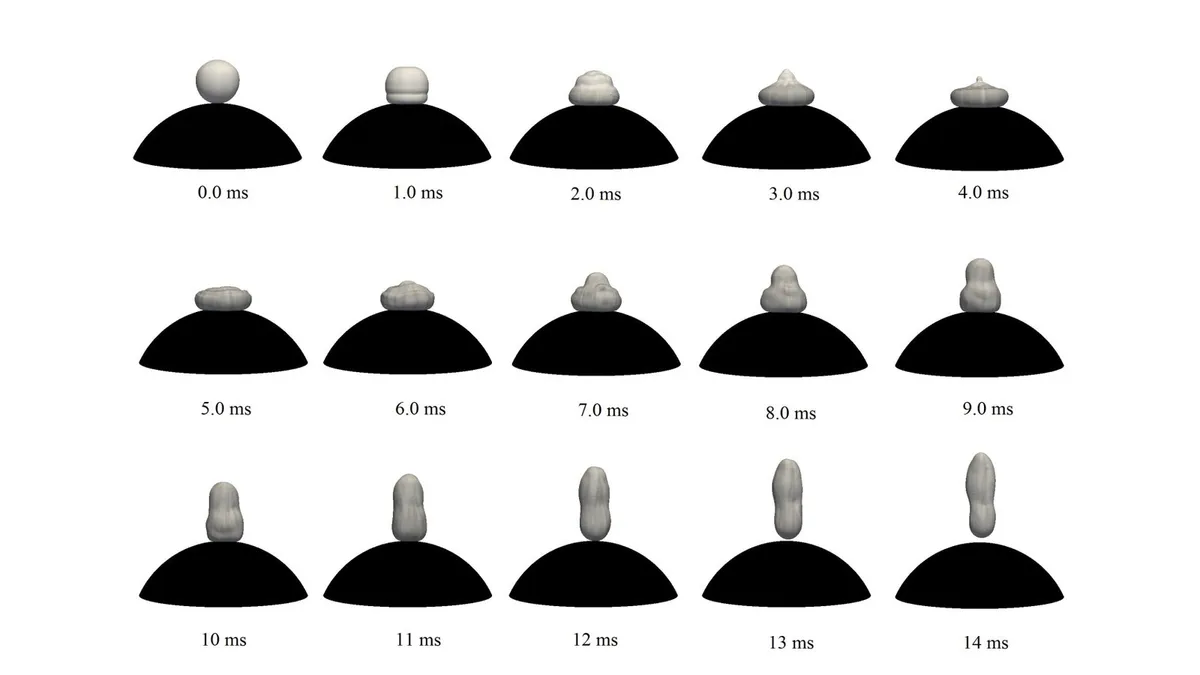
- Impact on a particle. Experiments and simulations of droplets hitting a heated spherical particle, which is closer to the geometry in a gas-solid reactor, including film boiling above the Leidenfrost temperature.
Approach
Measurements of droplet spread and Schlieren imaging of the vapour around evaporating droplets are paired with three-dimensional CFD. The simulations are validated against observed droplet shape and spread, and then used to separate the effects of Weber and Reynolds numbers, surface temperature and fluid properties on spreading, recoil, lift-off and evaporation rate.
Outputs
- Heat Transfer and Dynamics of Impinging Droplets on Hot Horizontal Surfaces
- Droplet impact dynamics on a spherical particle
- Modelling of the Interaction between a Falling N-Heptane Droplet and Hot Solid Surface
- Evaporation of a droplet on a heated spherical particle
Collaborators
Curtin University, the University of Newcastle, the National Chemical Laboratory (Pune) and IIT Bombay.
Contact
For collaboration or student projects on droplet and spray interactions with hot surfaces, contact the SMILE lab.