Hydrodynamics of FCC risers, strippers and catalyst circulation
Why it matters
Fluid catalytic cracking (FCC) is central to petroleum refining. Hot catalyst and vaporised feed move up a riser, spent catalyst is stripped of hydrocarbons, then regenerated and returned. Small gains in how well gas and catalyst contact each other, or how cleanly the catalyst is stripped, matter at the scale of these units.
The problem
Design and scale-up of FCC equipment is still largely empirical, because the gas-solid flow inside it is complex. In a riser the solids collect near the wall in a core-annulus pattern, which gives poor mixing and lowers performance. In a stripper, baffled countercurrent flow produces dead zones and local defluidization. Measuring inside industrial-style equipment is hard, and CFD models need data to be trusted.
What we do
- Model the riser. Simulate cold-flow and reactive flow, including droplet vaporisation and cracking kinetics, and review where current CFD models fall short.
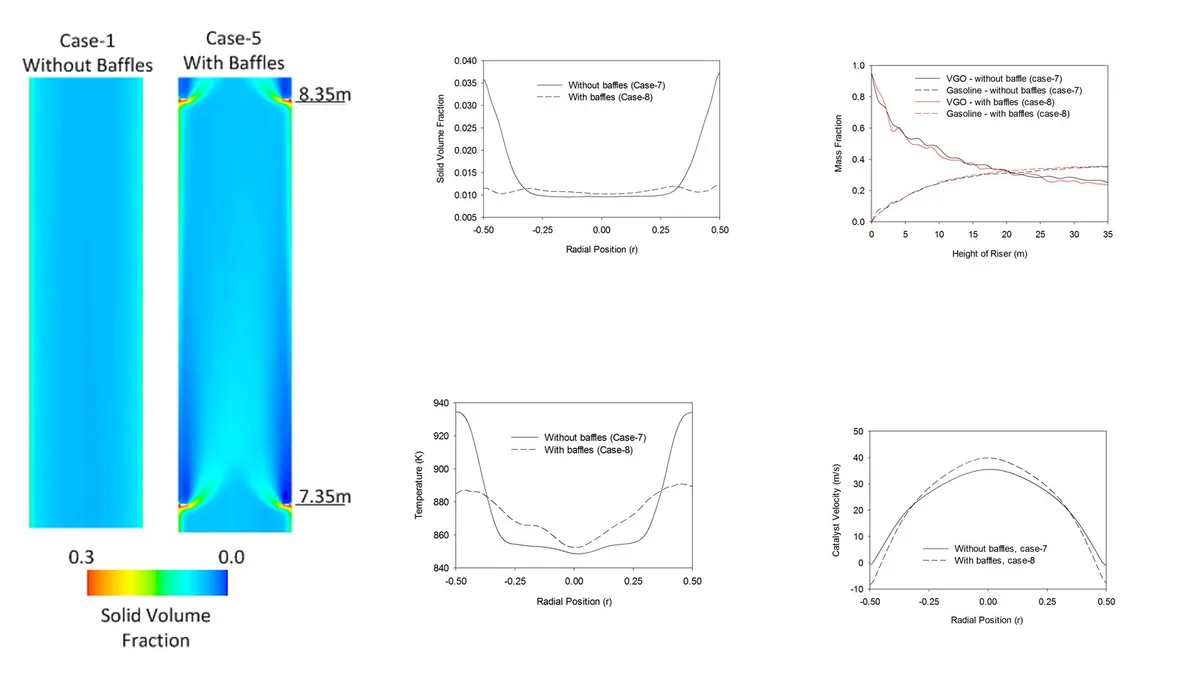
- Improve riser performance. Test internal baffles and pulsating gas flow as ways to even out the radial distribution of solids, temperature and species.
- Measure and simulate the stripper. Use gamma-ray densitometry on a scaled cold model with disk and donut baffles to measure solid holdup, and compare with three-dimensional CFD.
- Look at associated equipment. Simulate a catalyst lift engager from a continuous catalytic reformer, and review CFD of cyclone separators.
Approach
Eulerian-Eulerian CFD is paired with non-invasive measurements. Gamma-ray densitometry gives solid holdup at several heights and chordal positions without disturbing the flow, which tests the simulations on the features that matter, such as asymmetry, recirculation and dead zones. Closure models are chosen using the lessons from our gas-solid drag work.
Outputs
- Computational fluid dynamic modelling of FCC riser: A review
- Effect of Baffles on Performance of Fluid Catalytic Cracking Riser
- CFD study: Effect of pulsating flow on gas–solid hydrodynamics in FCC riser
- Hydrodynamics of a fluid catalytic cracking stripper using γ-ray densitometry
- Hydrodynamic Study of Fluid Catalytic Cracker Unit Stripper
- Gas–Solid Flow Hydrodynamics of an Industrial Scale Catalyst Lift Engager
- Hydrodynamic simulation of cyclone separators
Collaborators
Curtin University, the University of Newcastle, Indian Institute of Technology Delhi, and BP Kwinana Refinery.
Contact
For collaboration or student projects on refinery and fluidized bed hydrodynamics, contact the SMILE lab.