Multiscale modelling of gas-solid flow and drag
Why it matters
Gas-solid flows sit at the heart of circulating fluidized beds, fluid catalytic cracking, gasification, combustion and pyrolysis. Designing and scaling up these units still leans heavily on empirical rules, which leads to costly overdesign and lost productivity. Computational fluid dynamics (CFD) could do better, but only if the models capture what the particles are really doing.
The problem
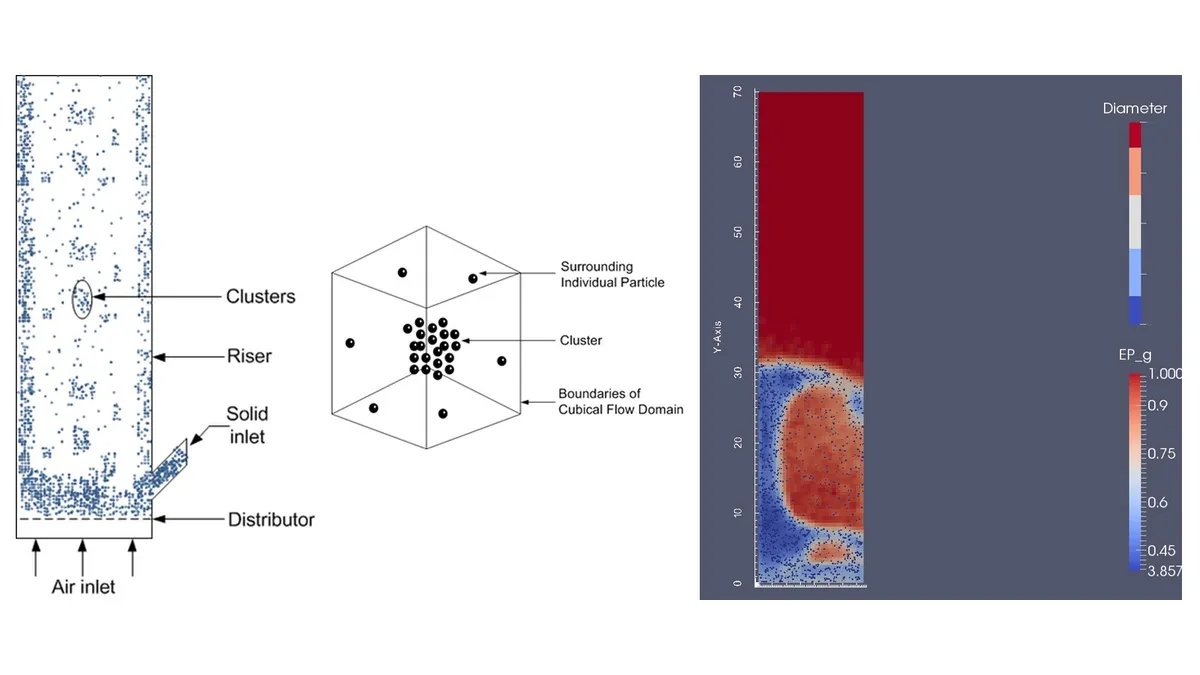
In fast fluidization, particles gather into clusters that continuously form and break up. Clusters sit between the particle scale and the equipment scale, yet they strongly reduce the effective drag between gas and solids. Conventional drag correlations assume a uniform suspension, so Eulerian-Eulerian simulations with them fail to capture the dense bottom, dilute top and core-annulus structure seen in real risers. Choices of closure models and boundary conditions add further uncertainty.
What we do
- Resolve the clusters directly. Use lattice Boltzmann simulations to compute the drag on a cluster of particles and show how cluster voidage, cluster fraction and Reynolds number change it.
- Build and test structure-based drag. Derive drag from the EMMS model, which accounts for cluster formation, and verify its assumptions against the lattice Boltzmann results.
- Test the closures in riser simulations. Compare drag models, cluster diameter correlations, wall boundary conditions, viscous stress models and inlet conditions against riser experiments at low and high solids flux.
- Extend to dense beds. Compare drag models in CFD-DEM simulations of bubbling fluidized beds with large (Geldart D) particles.
Approach
The work links scales. Particle-resolved lattice Boltzmann simulations act as a computational experiment where measurements are hard, and the findings feed drag laws used at the equipment scale. Those laws are then checked against published riser and fluidized bed data, so each modelling choice is judged by what it does to the predicted flow.
Outputs
- Verification of EMMS Formulation Using Lattice Boltzmann Simulations
- Effect of a cluster on gas–solid drag from lattice Boltzmann simulations
- Hydrodynamics of an FCC riser using energy minimization multiscale drag model
- Simulation of gas–solid flows in riser using energy minimization multiscale model: effect of cluster diameter correlation
- Effect of Inlet Boundary Conditions on Computational Fluid Dynamics (CFD) Simulations of Gas–Solid Flows in Risers
- Effect of closure models on Eulerian–Eulerian gas–solid flow predictions in riser
- Effect of drag models on CFD–DEM predictions of bubbling fluidized beds with Geldart D particles
- Estimation of Bubble Properties in Bubbling Fluidized Bed Using ECVT Measurements
Collaborators
Curtin University, the University of Newcastle, Homi Bhabha National Institute and the Institute of Chemical Technology Mumbai.
Contact
For collaboration or student projects on gas-solid flow modelling, contact the SMILE lab.