Phase-field modelling of dendrites in lithium-metal batteries
Why it matters
Growth in renewable energy needs better storage. Lithium-metal anodes could hold considerably more energy than the graphite anodes in lithium-ion cells today, but they are not yet commercial. The main obstacle is that lithium deposits unevenly during charging and grows dendrites. These can break off as dead lithium, reduce capacity and, if they reach the cathode, short-circuit the cell.
The problem
Dendrite shape depends on the electric field, the distance between electrodes and the crystal structure of lithium. To design ways of suppressing them, we need models that capture growth in three dimensions at the scale of real experiments, and that others can reproduce and extend.
What we do
- Reference models. Set out the phase-field formulations used for electrodeposition, compare conventional free energy and grand canonical forms, and check them against theoretical reaction kinetics, including a mesh convergence study.
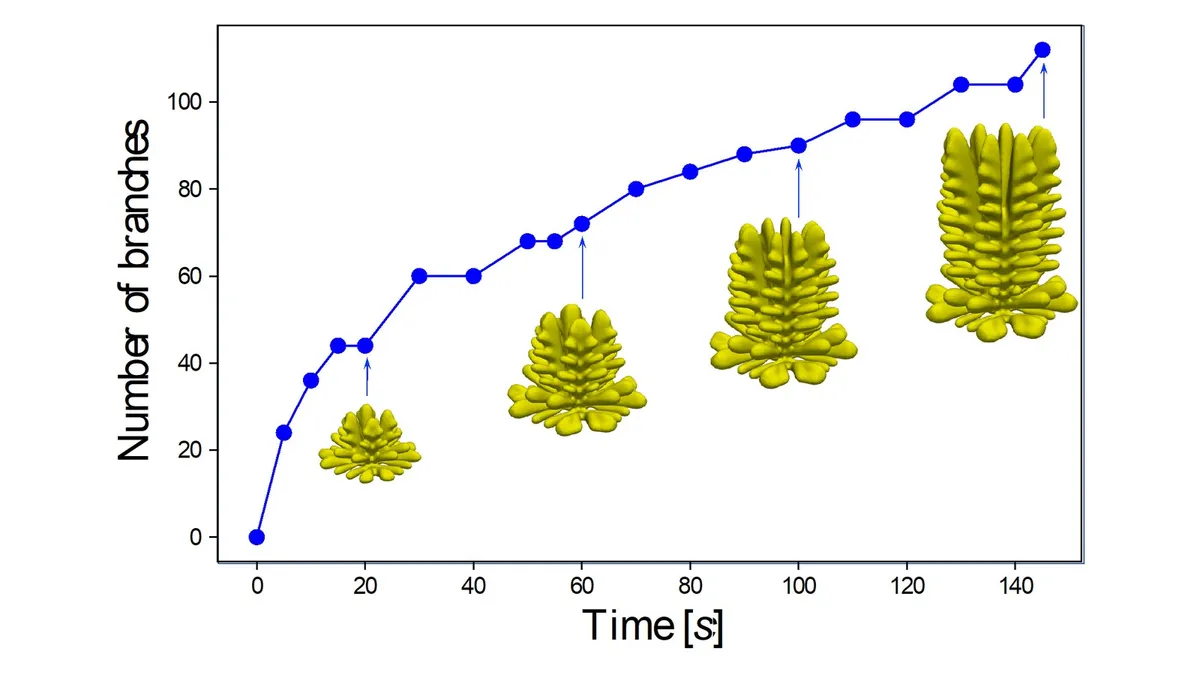
- Dendrite growth. Solve the coupled evolution of a phase field, lithium-ion concentration and electric potential through a charge cycle, in two and three dimensions.
- Experimental-scale 3D simulation. Add a modified representation of lithium surface anisotropy and simulate dendrites at experimental scale.
Approach
The equations are solved with an open-source finite element library, which gives parallel solvers and automatic time-step control. Simulated growth rates and morphologies are compared with those reported in experiments.
The 3D simulations show dendrites changing from smoother, tree-like forms at lower applied voltage to spike-like, highly branched structures at higher voltage. They point to dendrite formation as a competition between lithium-ion diffusion and electric migration, which bears on how to inhibit it.
Outputs
- Phase-field modeling of planar interface electrodeposition in lithium-metal batteries
- Dendrite formation in rechargeable lithium-metal batteries: Phase-field modeling using open-source finite element library
- Three-dimensional experimental-scale phase-field modeling of dendrite formation in rechargeable lithium-metal batteries
Collaborators
Curtin University and the University of Aberdeen.
Contact
For collaboration or student projects in battery and electrochemical modelling, contact the SMILE lab.