LNG ambient air vaporizers: heat transfer, fog and frost
Why it matters
Liquefied natural gas has to be turned back into gas at receiving terminals and satellite stations. Ambient air vaporizers do this with finned tubes and ambient air, so they burn no gas and do not need large volumes of seawater. That makes them cheap to run and attractive for small and large sites alike.
The same cold that vaporizes the LNG also causes trouble. Moisture condenses into fog around the units, frost builds up on the cold tubes and degrades heat transfer, and a spill produces a dense, cold vapour cloud whose behaviour affects site safety.
The problem
- Heat transfer to cryogenic LNG, including supercritical flow inside finned tubes, is hard to predict, and measured LNG data are scarce.
- Fog around vaporizer arrays reduces visibility, can recirculate to the air inlets, and changes local flow.
- Frost on cryogenic surfaces behaves differently from frost in refrigeration, and existing models do not cover it well.
- Dispersion of LNG vapour is usually treated as dry air, although condensing moisture changes the cloud.
What we do
- Vaporizer heat transfer. Model supercritical LNG flow in finned tubes and use the model to compare fin number, length and thickness.
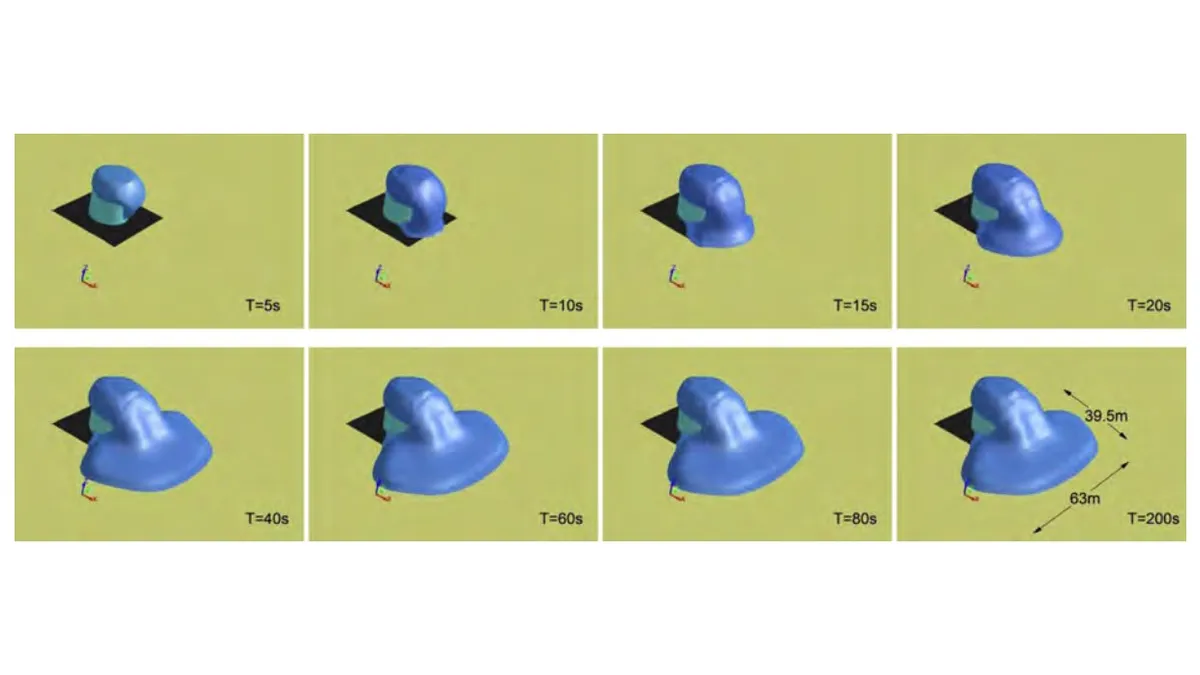
- Fog formation. Simulate natural convection, condensation and fog droplet transport around vaporizer units, and test the effect of wind, humidity and the number of units.
- Frost formation. Build multiphase models of frost growth from refrigeration down to ultra-low temperatures, and validate them against experiments.
- Vapour dispersion and risk. Predict dense-gas dispersion for risk assessment, and include fog as a second phase.
Approach
All of the work is computational fluid dynamics, checked against what data exist: empirical correlations and surrogate fluids (water and carbon dioxide) for supercritical flow, wind tunnel data for fog, frost experiments, and large-scale LNG field tests for dispersion. The aim is a set of validated tools that designers can use to size, space and site vaporizers.
Outputs
- Computational Fluid Dynamics Analysis of Liquefied Natural Gas Dispersion for Risk Assessment Strategies
- Modeling of Cryogenic Liquefied Natural Gas Ambient Air Vaporizers
- Numerical Study of Fog Formation around Ambient Air Vaporizers
- Multiphase Simulation of LNG Vapour Dispersion with Effect of Fog Formation
- Dynamic study of frost formation on cryogenic surface
- Investigation on Fog Formation of LNG Ambient Air Vaporisers
- Novel approach to modeling ultra-low temperature frost formation using Computational Fluid Dynamics
Collaborators
Curtin University, the University of Newcastle and Shanghai Jiao Tong University, with an industry partner.
Contact
For collaboration or student projects in cryogenic heat transfer and LNG safety modelling, contact the SMILE lab.