A novel settling tank for produced water treatment
Why it matters
Oil and gas production generates large volumes of produced water, often thousands of barrels a day, carrying suspended solids and oil droplets. These must be removed before the water is reused or returned to the sea, both for environmental compliance and to protect downstream equipment.
The problem
Fine particles settle slowly under gravity, so plain gravity settling is slow and impractical at scale. Membranes, centrifuges and hydrocyclones work, but each costs energy or limits capacity. The aim here was a continuous separator that is simple, with no moving parts, rotating elements or filter media, and whose performance is governed by the flow inside it.
What we do
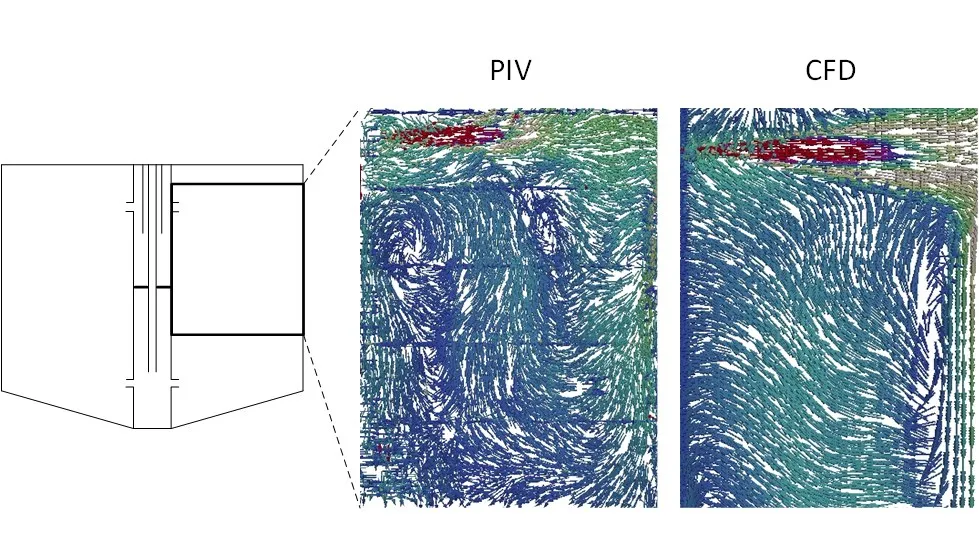
We designed and tested a new settling tank in which water enters through angled openings on a central hatch. The 30 degree angled entry sets up a swirling, whirlpool-type flow: water moves down near the wall and inward along the bottom, which carries particles to the centre of the tank floor where they collect.
Approach
- Experiments. Particle image velocimetry (PIV) on a transparent, scaled-down tank measured the velocity field.
- Validation. The CFD model was checked against the PIV data.
- Design study. The validated model was used to follow particles of different sizes while varying flow rate, inlet opening size and outlet position.
A key finding is that flow rate must be matched to the design: too high and settled solids are lifted again and recirculated, which hurts separation. In the simulations the tank captured more than 80% of particles in the 30 to 1000 micrometre range at its design operating rate. Higher throughput would need different internals, more inlets or a reshaped tank bottom, and the effect of a long-term particle bed still needs study.
Outputs
Collaborators
Curtin University and Chevron, with funding support from the Western Australian Energy Research Alliance (WA:ERA).
Contact
For collaboration or student projects on separation equipment and CFD-guided design, contact the SMILE lab.