Solid oxide fuel cell modelling from cell to system
Why it matters
Solid oxide fuel cells convert fuel directly to electricity with high efficiency and low emissions, and can run on fuels such as hydrogen, biogas or reformed hydrocarbons. What holds them back is durability. Temperature gradients and uneven fuel supply inside a cell or stack shorten its life, and experiments on stacks are expensive.
The problem
Commercial process simulators have no built-in SOFC module, so a fuel cell is usually treated as a lumped black box. That hides the internal conditions that decide whether a stack lasts: thermal hotspots, local fuel starvation and slow transients. Full CFD can resolve them, but it is too costly to use for system studies or control.
What we do
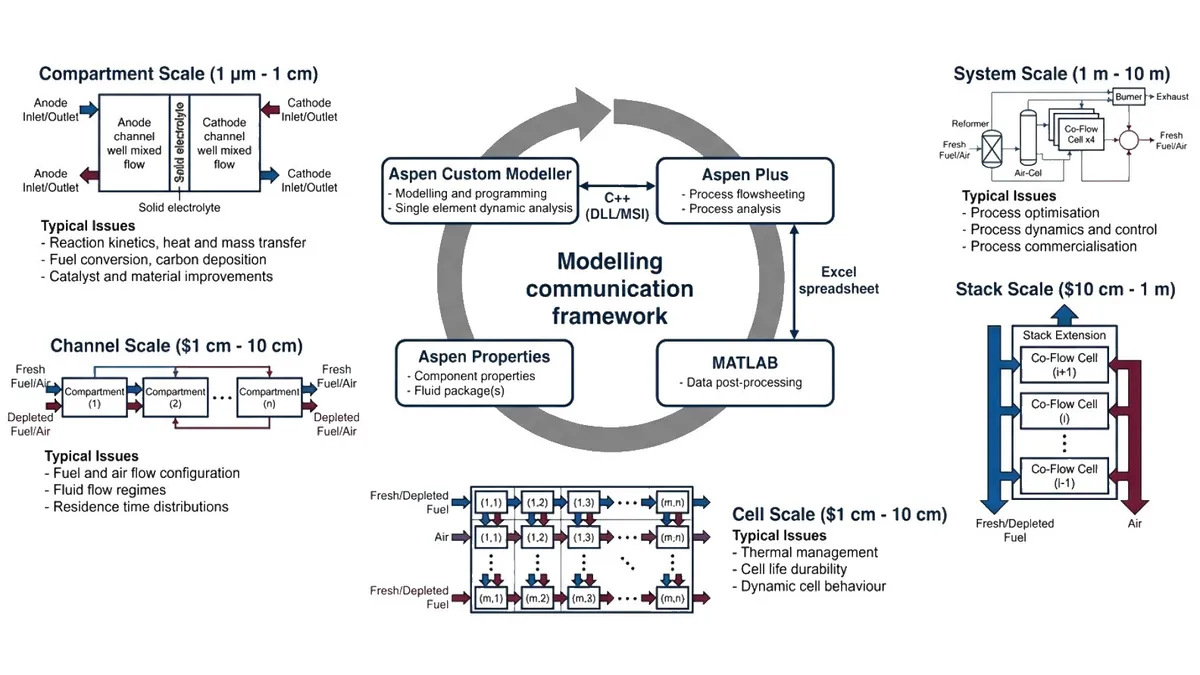
- Multi-scale modelling. Build a rigorous SOFC module inside a flowsheet simulator, from a single compartment up through channel, cell, stack and system, so that stack behaviour and the surrounding plant can be studied together.
- Fast dynamic models. Represent a direct internal reforming cell as tanks in series. This keeps the spatial and transient behaviour at a small fraction of the computing cost of CFD.
- State estimation. Design an observer that estimates temperatures, species concentrations and unmeasured inputs from limited measurements.
Approach
The models are checked against experimental data, and CFD is used for spatial profiles. The stack-scale studies look at flow maldistribution in the manifold and at recycling depleted anode gas, which can be used to manage gradients and improve fuel utilisation and water management. The tank-in-series model reproduced experimental voltage-current curves to within about 1.5%.
Outputs
- Simultaneous estimation of states and inputs in a planar solid oxide fuel cell using nonlinear adaptive observer design
- Solid oxide fuel cell reactor analysis and optimisation through a novel multi-scale modelling strategy
- Planar SOFC system modelling and simulation including a 3D stack module
- Dynamic Tank in Series Modeling of Direct Internal Reforming SOFC
Collaborators
Curtin University and Ceramic Fuel Cells Ltd.
Contact
For collaboration or student projects in fuel cell and reactor modelling, contact the SMILE lab.