Kafirin from sorghum: continuous purification and biomaterials
Why it matters
Sorghum is a drought-tolerant cereal and is safe for people with coeliac disease. Its main storage protein, kafirin, is hydrophobic and has properties that suit food-grade biomaterials: delayed-release drug delivery matrices, coatings for pharmaceuticals and nutraceuticals, and edible films.
Kafirin is also present in dried distillers grain with solubles (DDGS), the protein-rich by-product of bioethanol production, which is currently treated as a low-value stream.
The problem
Kafirin is hard to make at scale. Its hydrophobicity limits industrial production in a food-compatible form, and there was little data on how it behaves on the chromatography resins that a scalable purification would use. It is also not clear how kafirin recovered from heat-processed DDGS compares with kafirin from the grain.
What we do
- Adsorption data for process design. Measure how kafirin binds to ion-exchange resins (equilibrium isotherms and kinetics) so that resins can be chosen and columns sized on evidence.
- Continuous purification. Model a liquid-solid circulating fluidized bed (LSCFB), in which adsorption and desorption run at the same time in two linked columns, so that purification is continuous rather than batch.
- Source and variety. Compare kafirin extracted from sorghum grain and from DDGS, and screen sorghum varieties for kafirin content.
- Biomaterial properties. Characterise the protein’s structure and surface to judge what it can be used for.
Approach
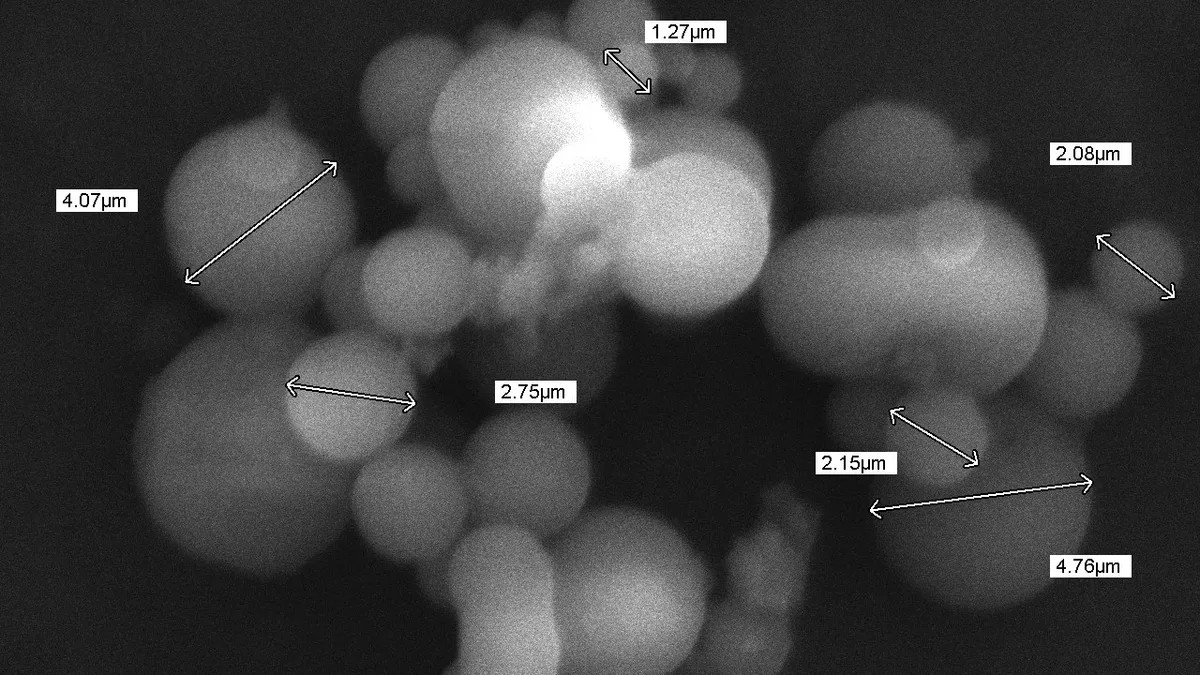
The work combines batch laboratory experiments with computational modelling. The LSCFB model uses a tanks-in-series description of each column and takes its adsorption parameters from the batch isotherm and kinetic experiments. It is used to see how solids circulation rate, liquid velocities, degree of mixing and feed concentration affect production rate, recovery and the amount of resin needed. Protein characterisation uses gel electrophoresis, infrared spectroscopy, X-ray diffraction and scattering, and electron microscopy. In the image above, an electron micrograph shows kafirin as microspheres a few micrometres across.
Outputs
- Modelling and numerical simulation of liquid–solid circulating fluidized bed system for protein purification
- Kafirin Adsorption on Ion-Exchange Resins: Isotherm and Kinetic Studies
- Physicochemical characterisation of kafirins extracted from sorghum grain and dried distillers grain with solubles related to their biomaterial functionality
Collaborators
Curtin University (chemical engineering and food science), the Institute of Chemical Technology in Mumbai, Charles Sturt University and the University of Kashmir.
Contact
For collaboration or student projects in cereal protein processing and bioseparation, contact the SMILE lab.