Gas-liquid and solid-liquid stirred tanks
Why it matters
Stirred tanks are among the most widely used vessels in the process industries. They keep solids suspended for leaching, adsorption, crystallisation and effluent treatment, and they disperse gas into liquid for reaction and mass transfer. In gold processing, for example, a series of stirred tanks carries the carbon-in-leach circuit, and dead zones, short-circuiting or unsuspended solids directly reduce its efficiency.
The problem
Predicting what happens inside a stirred tank is hard because several things interact at once:
- Solids and liquid exchange momentum through drag, and turbulence changes that drag.
- At high solid loadings, particle-particle and particle-wall collisions can no longer be ignored.
- Gas dispersion depends on impeller type, blade angle and baffling, and the gas phase is difficult to measure without disturbing the flow.
What we do
We combine CFD with experiments in laboratory tanks so that each checks the other.
- Solid suspension. Euler-Euler CFD of solid-liquid tanks from low to dense solid loadings, including a drag law corrected for strong turbulence, and granular-flow models for the dense end.
- Carbon-in-leach tanks. CFD of flow and solids distribution at high solid loading, and a dynamic process model of the whole circuit used for multi-objective optimisation.
- Gas dispersion. The effect of high solidity pitched blade turbine (HSPBT) blade angle on gas holdup, power and bubble properties.
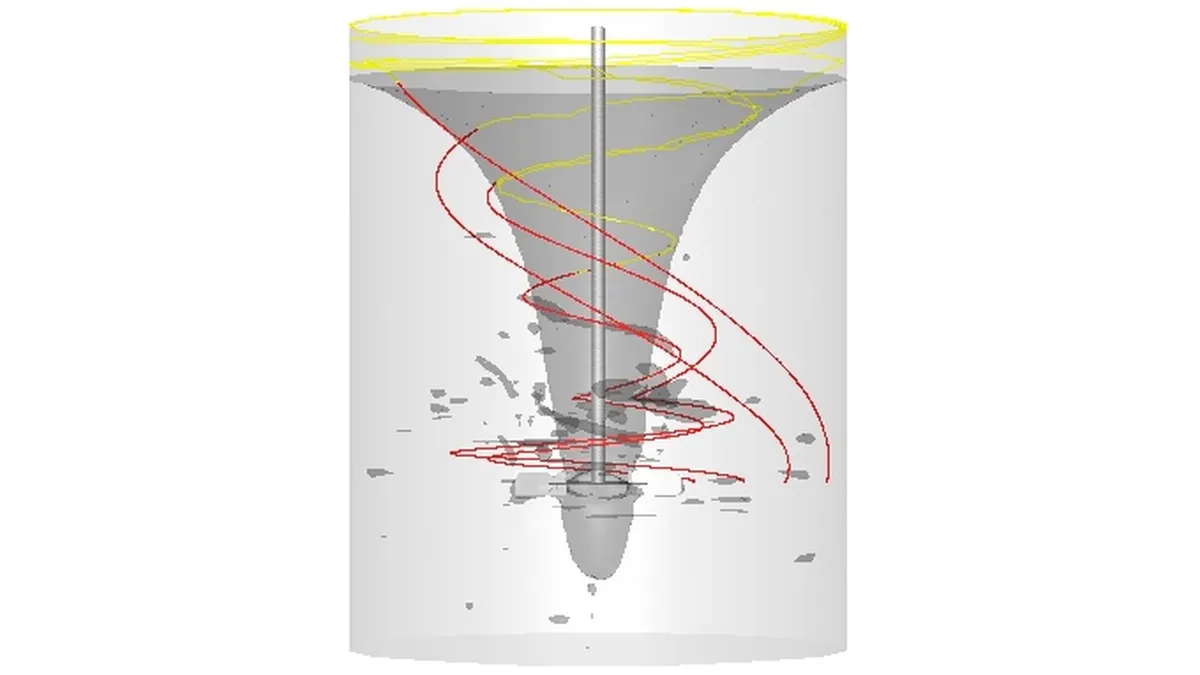
- Unbaffled tanks. How impeller speed and vortex ingestion set the vortex shape and the gas-liquid hydrodynamics.
Approach
Simulations use multiphase CFD, with the multiple reference frame approach for the impeller and Reynolds stress turbulence models where the flow demands them. Experiments use an optical probe that measures local gas holdup, bubble size and velocity, and in later work both phases at once. Measurements validate the models, and the validated models are then used to explore design and operating changes that are costly to test at scale.
Outputs
- CFD simulation of solid–liquid stirred tanks
- CFD simulation of solid–liquid stirred tanks for low to dense solid loading systems
- CFD modelling of flow and solids distribution in carbon-in-leach tanks
- Modeling and Optimization of Carbon in Leach (CIL) Circuit for Gold Recovery
- Impact of HSPBT Blade Angle on Gas Phase Hydrodynamics in a Gas–Liquid Stirred Tank
- Simultaneous Measurements of Two Phases Using an Optical Probe
- Vortex Shape and Gas-Liquid Hydrodynamics in Unbaffled Stirred Tank
Collaborators
Curtin University (chemical engineering), with industry partners in mineral processing and related sectors.
Contact
For collaboration or student projects on stirred-tank and slurry mixing, contact the SMILE lab.