SpiroPak: 3D-printed structured packing
Why it matters
Distillation and absorption columns sit at the heart of gas processing, refining and chemical manufacture, and structured packing is what brings the gas and liquid into contact inside them. Its pressure drop sets the energy needed to push gas through the column, and its capacity sets how much a column can process. Conventional packings are built from corrugated metal sheets, a design shaped largely by what is easy to manufacture.
The problem
Additive manufacturing removes that constraint, but it is not obvious which geometries are worth printing. Designers need to know how corrugation angle, channel size and surface features each affect pressure drop, liquid holdup and flooding, and how liquid spreads across a bed when the column is not perfectly vertical, as on a floating offshore facility.
What we do
- Geometry studies. Vary packing geometry parameters systematically and quantify their effect on gas-liquid hydrodynamics.
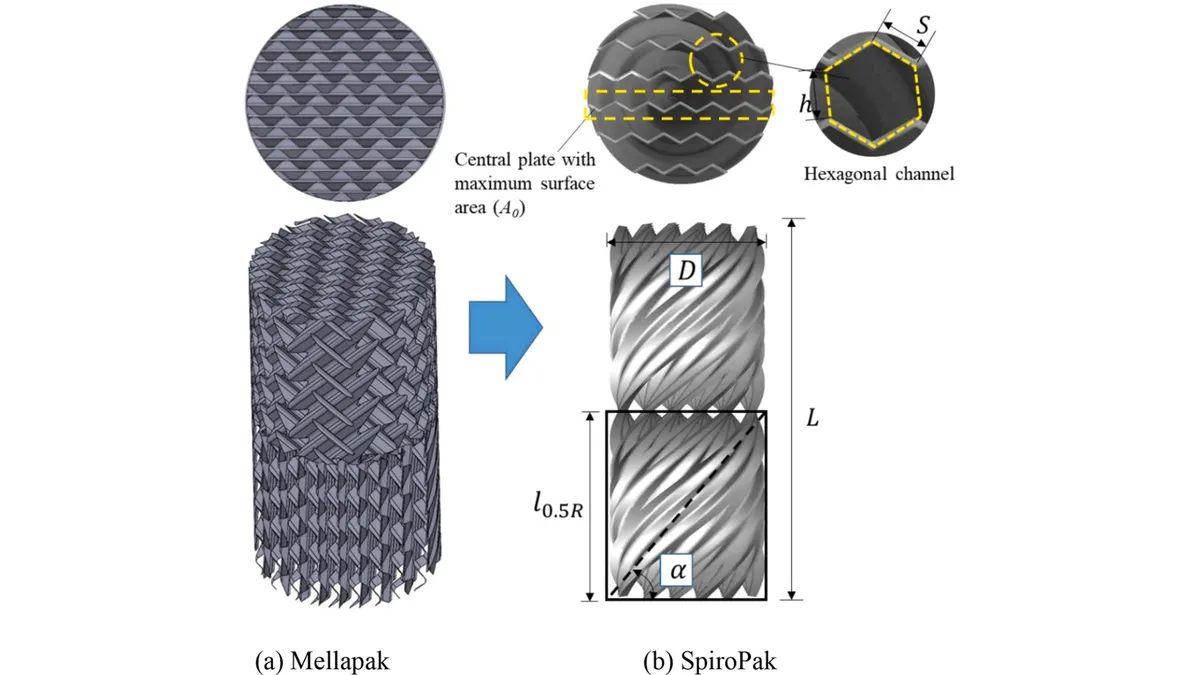
- SpiroPak. Design a spiral packing with hexagonal channels that gives gas and liquid uninterrupted flow paths, and compare it with a conventional packing (Mellapak).
- Liquid spreading. Simulate how inclination and oscillation change liquid distribution in trickle beds.
Approach
We combine CFD with experiments on a purpose-built test column. The CFD models are checked against measured pressure drop for replicas of commercial packings and SpiroPak, then used to explore geometry changes that would be slow or costly to test by printing each one. Geometry is the design variable, so the same workflow applies to other printed internals.
Outputs
- Hydrodynamics of a novel 3D printed structured packing – SpiroPak
- Study on Hydrodynamic Performance of Structured Packings for Gas-Liquid Flow: Effects of Geometry Parameters
- US patent: Structured packing
- Effect of Column Inclination and Oscillation on Liquid Spreading in a Trickle Bed
Collaborators
Curtin University and the University of Newcastle, with industry input on gas-processing applications.
Contact
For collaboration or student projects on packing design, additive manufacturing of process internals or column hydrodynamics, contact the SMILE lab.